Castorocauda
Earliest known aquatic mammaliaform with fur and beaver-like tail.

Castorocauda is an extinct genus of docodont mammaliaforms from the Middle to Late Jurassic, known from the Daohugou Beds of Inner Mongolia, China.
- species
- Castorocauda lutrasimilis
- location
- Daohugou Beds, Inner Mongolia, China
- known_for
- Earliest known mammaliaform with aquatic adaptations and fur pelt; largest Jurassic mammaliaform
Lore & Background
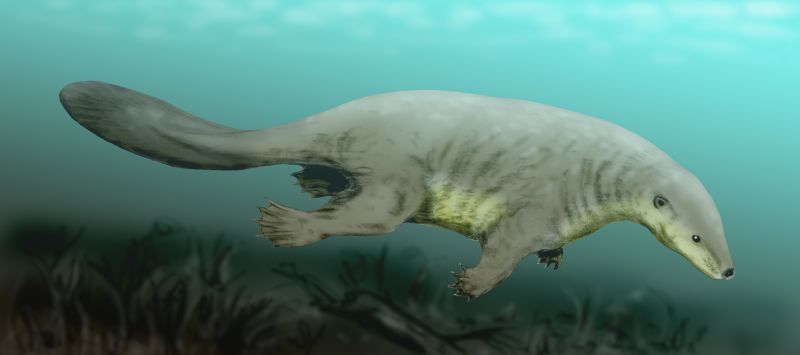
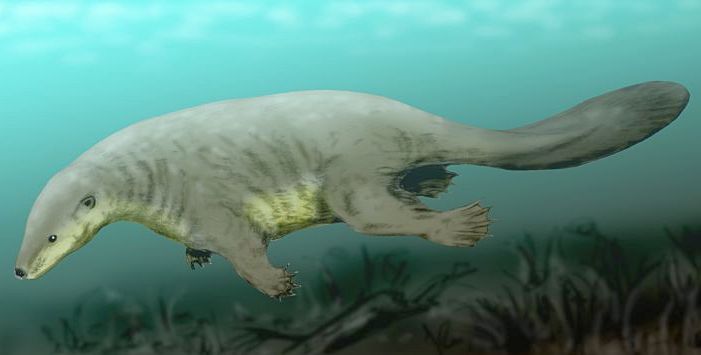
Castorocauda lived in a wet, seasonal, cool temperate environment, possibly with an average temperature below 15 °C. It shared its habitat with salamanders, pterosaurs, birdlike dinosaurs, and other mammaliaforms. Its teeth curved backward to grip slippery fish, similar to seals and Eocene whales, and its forelimbs resembled those of the modern platypus, adapted for both digging and rowing. The tail vertebrae were flattened and similar to beavers and otters, suggesting use in paddling and propulsion. Fur preserved on the holotype represents the earliest known pelt, indicating that fur was an ancestral trait of mammals.
Reader's Guide
Castorocauda is significant as the earliest known mammaliaform with clear aquatic adaptations, pushing back the first appearance of such traits by over 100 million years. Its discovery, along with other unusual mammaliaforms from the Yanliao Biota, disproved the long-held view that mammaliaforms were small, ground-dwelling, and evolutionarily stagnant until after the extinction of non-avian dinosaurs. Instead, it shows a Middle Jurassic explosive radiation into diverse niches, including semi-aquatic, burrowing, and gliding forms. Castorocauda's combination of features—webbed feet, a beaver-like tail, fur, and fish-gripping teeth—suggests an ecology similar to modern platypuses and river otters. It also provides evidence that fur and a well-developed neocortex were present early in mammaliaform evolution. The species is part of the Docodonta order, though its exact relationships within the group remain uncertain, with some analyses placing it close to Dsungarodon. Its fossils, including soft tissue and hair, offer rare insight into the biology of Jurassic mammaliaforms.
Did You Know?
- It is the earliest known mammaliaform with aquatic adaptations and a fur pelt.
- Its tail vertebrae are flattened and similar to those of beavers and otters, used for paddling.
- The holotype preserves a spur on the hind ankle, but unlike the male platypus, there is no evidence this spur was venomous.
A Place Among the Cynodonts
Castorocauda occupies a specific position within the broader group of non-mammalian cynodonts, a lineage that sits at the intersection of reptile-like and mammal-like features in the synapsid family tree. Within Cynodontia, it belongs to the docodont subgroup, a branch of these early mammal relatives that represents one of the more specialized offshoots of the group. The available facts place it alongside other notable cynodonts such as Scalenodontoides, the largest known non-mammalian cynodont overall with a skull of roughly 61.7 centimetres, and Paceyodon davidi, the largest morganucodontan. Castorocauda, however, is distinguished not by skull measurements but by its overall body length, making it the standout representative of the docodont lineage in terms of sheer size. Its classification as a non-mammalian cynodont means it predates true mammals while sharing certain anatomical heritage with them, placing it in a transitional evolutionary window that fascinates paleontologists studying the origins of mammalian traits.
Measuring the Beast
The single most concrete figure associated with Castorocauda is its body length: almost 50 centimetres, or roughly 20 inches. In the context of prehistoric fauna, this places it firmly in the small-to-medium range, far from the giants like Lisowicia bojani at 4.5 metres or the massive multituberculate Taeniolabis taoensis which may have exceeded 100 kilograms. Yet within its own docodont family, this nearly half-metre frame was the largest ever recorded. The measurement of almost 50 centimetres suggests the estimate falls just short of the half-metre mark, a detail that reflects the inherent uncertainty in reconstructing body dimensions from partial skeletal remains. Unlike some of its contemporaries whose sizes are given as ranges, such as Anteosaurus at 5 to 6 metres, Castorocauda's figure is presented as a single approximate value, underscoring that the fossil evidence available for this particular animal yields a relatively narrow, though still estimated, size window.
The Largest of Its Kind
Within the docodonts, a subgroup of non-mammalian cynodonts, Castorocauda holds the distinction of being the largest known representative. This title is meaningful because the docodonts, while part of the broader cynodont radiation that includes animals like Scalenodontoides and Paceyodon davidi, form their own distinct branch. Being the largest known docodont does not necessarily mean it was the largest cynodont overall, since Scalenodontoides, a traversodontid, had a maximum skull length of approximately 61.7 centimetres based on a fragmentary specimen. Nor was it the largest non-mammalian synapsid, a title held by the dicynodont Lisowicia bojani at around 4.5 metres in length. Castorocauda's claim to size supremacy is therefore specific to its immediate family, a reminder that the fossil record's patchy nature means the title of largest is always relative to the particular clade under consideration and the quality of specimens that have survived to the present day.
What the Bones Cannot Tell Us
The size figure of almost 50 centimetres for Castorocauda is, like most measurements of extinct animals, an estimate rather than a definitive reading. The broader context of prehistoric size reconstruction makes clear that the fossil record is inherently incomplete, and many species mentioned in such compilations may not actually be the true largest representatives of their clade. Body mass, especially, remains largely conjecture because soft tissue was rarely preserved in the fossil record. For Castorocauda, this means we cannot reliably state its weight, the thickness of its musculature, or the extent of any integumentary features. Its size was also subject to the same energetic and biomechanical constraints that governed all extinct species, meaning its nearly half-metre frame represented a body that had to support itself, move, and feed within the physical limits of its era. The absence of a complete specimen compounds these uncertainties, leaving the exact proportions and mass of this largest docodont as an open question in paleontology.
Gallery
Frequently Asked Questions
Who is Castorocauda?
Castorocauda lutrasimilis is a docodont mammaliaform from the Middle to Late Jurassic, recognized as the largest known mammaliaform of that era. It is best remembered as the earliest mammaliaform to show clear aquatic specializations paired with a full fur coat.
What makes Castorocauda's body unique?
It carried a dense pelt of fur and a broad, flattened tail resembling that of a modern beaver, adaptations that point to a life spent largely in water. No earlier mammaliaform is known to combine body hair with such aquatic features.
Where was Castorocauda discovered?
Fossils of this genus come from the Daohugou Beds in Inner Mongolia, China, a site celebrated for its remarkably detailed Jurassic vertebrate preservation.
How does Castorocauda fit into early mammal evolution?
As a docodont, it belongs to one of the oldest lineages of mammaliaforms, yet its aquatic toolkit shows that water-adapted niches were already being exploited by the Middle Jurassic. It therefore pushes back the known timeline for ecological diversification among early mammal relatives.
Why is Castorocauda considered a landmark find?
It simultaneously holds the records for the largest Jurassic mammaliaform and the earliest example of a furry, water-adapted mammaliaform. Its discovery forced paleontologists to rethink how ecologically varied early mammal relatives were before the Cretaceous.
More in Prehistoric Beasts 25-34
Elsewhere in the Prehistoric Beasts universe
Spotted an error? Know more?
This is a living reference — every entry is fact-audited, and reader corrections feed straight into our audit queue. Suggest an edit · See this site's audit record