Champsosaurus
Extinct crocodile-like reptile from the Late Cretaceous and Paleogene.

Momotarou2012 · CC BY-SA 3.0
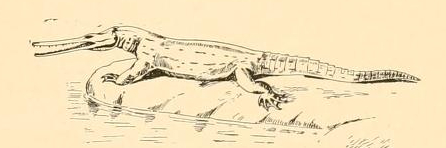
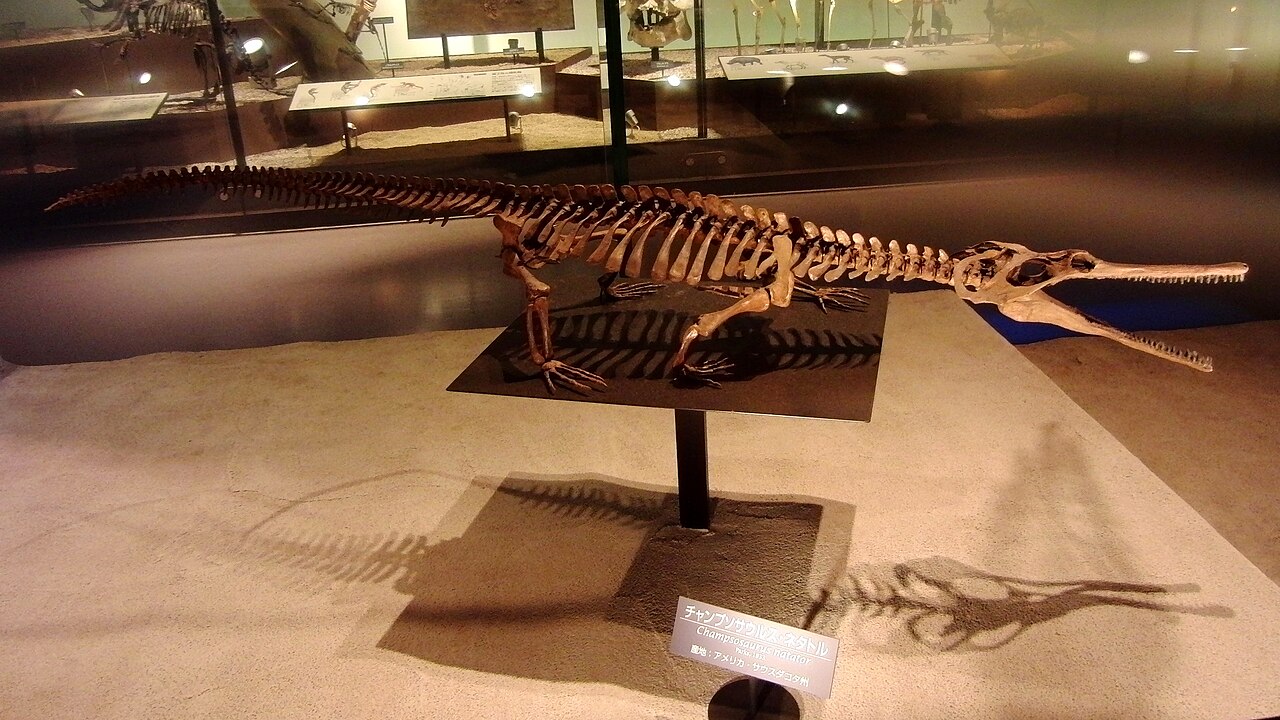
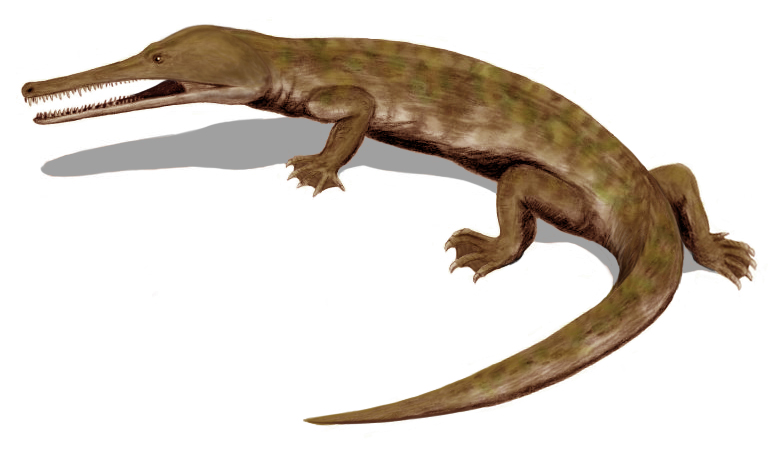
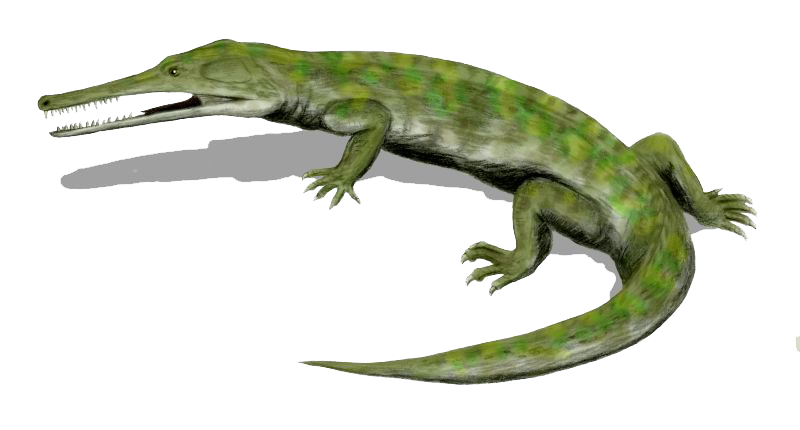
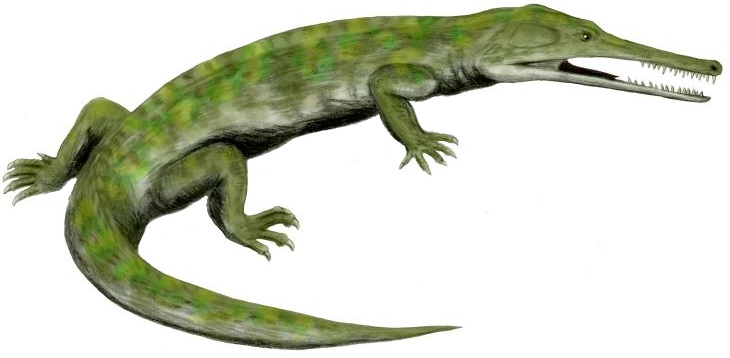
Champsosaurus is an extinct genus of crocodile-like choristodere reptile known from the Late Cretaceous and early Paleogene periods of North America and Europe. Its morphology resembles that of gharials, with a long, elongated snout, and it inhabited freshwater environments where it likely preyed on fish.
- field
- Paleontology
- known_for
- First described choristodere reptile; gharial-like aquatic predator
- time_period
- Late Cretaceous to early Paleogene (Campanian–Paleocene)
- locations
- North America (Alberta, Saskatchewan, Montana, New Mexico, Texas, Colorado, Wyoming) and Europe (Belgium, France)
- size
- Most species ~1.50 m; largest species Champsosaurus gigas reached 3–3.5 m
Lore & Background
Cope designated C. annectens as the type species, though later researchers considered the vertebrae undiagnostic, making C. annectens a nomen vanum or nomen dubium. Brown named C. ambulator and C. laramiensis from the Hell Creek Formation. Subsequent species were named by William Parks (C. albertensis, C. natator), Denise Sigogneau-Russell (C. dolloi from Belgium), Bruce Erickson (C. gigas, C. tenuis), and K. Q. Gao and Richard Carr Fox (C. lindoei).
Reader's Guide
Champsosaurus holds significance as the first described member of the Choristodera, a group of aquatic reptiles. Its fossils, found across North America and Europe, span the Late Cretaceous to late Paleocene, with tentative remains from the high Canadian Arctic during a period of extreme warmth. The genus exhibits specialized aquatic adaptations: a dorsoventrally flattened skull, elongated gharial-like snout, heavy gastralia, and skin impressions showing small pustulate and rhomboid scales without osteoderms. Its braincase suggests good olfactory capabilities and sensitivity to low-frequency sounds and vibrations, but poor hearing of airborne sounds. The teeth, with striated enamel and palatal rows, likely aided in gripping fish. Champsosaurus belongs to Neochoristodera, a clade that first appeared in the Early Cretaceous of Asia, possibly evolving in the absence of aquatic crocodyliformes. The relationships within Neochoristodera remain uncertain, often recovered as a polytomy. The genus illustrates the diversity of freshwater reptiles during the Cretaceous–Paleogene transition.
Did You Know?
- The name Champsosaurus is thought to come from an Ancient Greek source that said an Egyptian word for 'crocodiles' (champsai) and the Greek word for 'lizard' (sauros).
- The type species Champsosaurus annectens is considered a nomen vanum or nomen dubium because its vertebrae are undiagnostic to species level.
- Skin impressions of Champsosaurus show small pustulate and rhomboid scales, with the largest scales on the sides of the body and no osteoderms present.
- Champsosaurus likely had good olfactory capabilities but poor ability to detect airborne sounds, lacking a tympanum.
A Fossil Among Many: The Queue Display
The Champsosaurus fossil found its place in the public eye not in a museum hall but in the winding indoor queue of a Disney dark ride. At Disney's Animal Kingdom in Bay Lake, Florida, visitors waiting for the Dinosaur attraction would pass through a first section of the indoor queue where several small exhibits caught the eye. Among a collection of small fossils—Champsosaurus, Dromaeosaurus, and Protostega being named examples—guests could also find displays of modern animals whose lineages trace back to the age of dinosaurs, alongside evidence supporting various theories of mass extinction. For the Champsosaurus specimen, this queue display represented a quiet but persistent presence: a small fossil among many, part of a broader educational tableau that framed the prehistoric journey riders were about to take.
The World That Gave It a Stage
The Champsosaurus fossil was one thread in a much larger tapestry: the Dinosaur attraction at Disney's Animal Kingdom. This dark ride EMV experience transported guests through the late Cretaceous period in a turbulent journey filled with prehistoric scenes populated by dinosaur audio-animatronics. Two dinosaurs stood out as the attraction's stars—the Iguanodon and the Carnotaurus—both of which also appeared in Disney Animation's feature film of the same name. Scenes from that movie were woven into the pre-show, blurring the line between the animated story and the physical ride. For a creature like Champsosaurus, whose fossil sat modestly in the queue, the surrounding spectacle of roaring animatronics and cinematic storytelling gave context and contrast to its quiet, mineralized remains.
A Champsosaurid on the Menu
While the Champsosaurus itself appeared only as a static fossil in the queue, a close relative brought the champsosaurid lineage to life in the ride's action sequence. After the time rover deposited guests into the prehistoric landscape—where the smell of forest and trees filled the air—the scene included an Alioramus in the act of eating a Brachychampsa. This moment placed a member of the same broader family as Champsosaurus squarely in the food chain of the late Cretaceous world the attraction depicted. The surrounding cast of creatures was equally vivid: a Styracosaurus, a Parasaurolophus (labeled as a hadrosaur) watching over its young, and a Velociraptor (called a raptor) all populated the landscape. The Brachychampsa's fate as prey underscored the peril of that era, a theme that echoed through the rest of the ride as the countdown to the mass-extinction asteroid ticked down and the rover sped through increasingly darkened terrain.
The End of an Era
The Champsosaurus fossil's home—the Dinosaur attraction and the broader DinoLand U.S.A. area—met its end as part of a sweeping transformation at Disney's Animal Kingdom. For the Champsosaurus fossil, this closure marks the end of its public display in a theme park queue. Its story, like that of the creature it represents, becomes a relic of a bygone configuration of the park, preserved in the memories of guests who once paused beside it while waiting to board a time rover.
Gallery
Frequently Asked Questions
What is Champsosaurus?
Champsosaurus is an extinct genus of choristodere reptile that lived during the Late Cretaceous and early Paleogene periods. It is best recognized as the first formally described member of the choristodere group and is often compared to modern gharials because of its elongated snout.
What did Champsosaurus look like?
It had a very long, narrow snout closely resembling that of a gharial, giving it a distinctly crocodile-like silhouette. Despite the visual similarity, it was actually a choristodere rather than a true crocodylian.
How big was Champsosaurus?
Most species of Champsosaurus measured roughly 1.5 meters in total length. The largest known species, C. gigas, could reach 3 to 3.5 meters.
Where and when did Champsosaurus live?
Fossils have been recovered across North America (Alberta, Saskatchewan, Montana, New Mexico, Texas, Colorado, Wyoming) and in Belgium and France. It inhabited freshwater settings during the Campanian through Paleocene and likely fed primarily on fish.
Why is Champsosaurus important to paleontology?
It holds the distinction of being the first choristodere reptile ever formally described, making it a foundational reference for the entire group. Its widespread fossil record spanning two continents also helps scientists reconstruct Late Cretaceous freshwater ecosystems and their biogeography.
More in Prehistoric Beasts 25-34
Elsewhere in the Prehistoric Beasts universe
Spotted an error? Know more?
This is a living reference — every entry is fact-audited, and reader corrections feed straight into our audit queue. Suggest an edit · See this site's audit record